First 30 days on a chaotic project: a checklist
- Gloria Ciavarrini
- Open source , Software engineering , Teamwork
- March 11, 2026
This is the second post in a series on bringing structure to complex projects. Start with Bringing structure to chaos.
When you join a chaotic, multi-component project, the first weeks can feel overwhelming. Where do you even start? I’ve been there. Over time, I’ve developed a mental checklist that helps me navigate the first 30 days without getting lost in the noise. I’m sharing it here, not as a prescription, but as a structure you can adapt.
Week 1: Map the territory
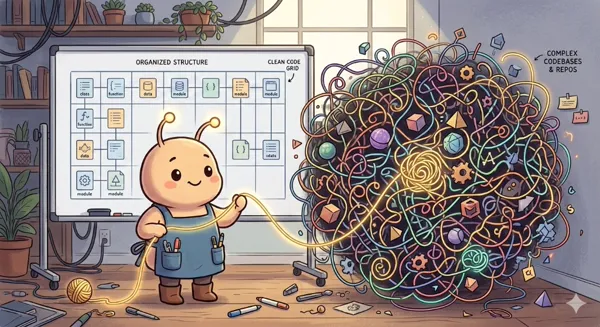
The first week is about orientation. You need to understand the landscape: which repositories exist, what each one does, where the main entry points are. Find the existing documentation, architecture diagrams, Miro boards. Don’t expect them to be complete. They rarely are. The goal is to get oriented.
When it comes to people, I deliberately keep the circle small. I pick two or three people with different perspectives, maybe someone who’s been there longest, an architect, and an engineer actively contributing. That gives me multiple points of view without relying on a single source of truth. If one person says “the real problem is X” and another says “actually it’s Y,” that’s useful. It tells you there’s no shared understanding yet.
To capture what I learn, I draw. High-level diagrams help me see how the pieces fit together: repos, data flow, who owns what. I sketch them by hand first. That’s how I clarify my own thinking, though your mileage may vary. Then I turn them into something shareable and correct them as I go. The act of drawing forces you to make your mental model explicit.
Week 2: Find the gaps
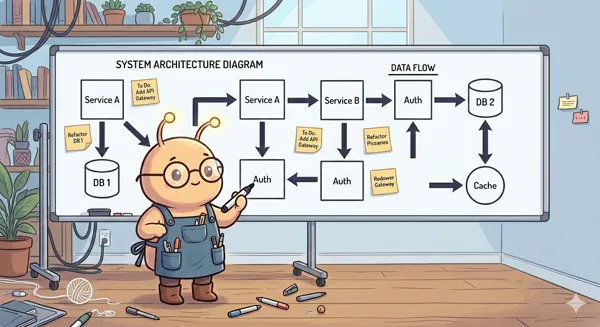
By week two, you’re starting to see where things break down. Identifying gaps is what helps me understand the problems. If I know a problem exists, as an engineer I can try to act and find a solution. If I don’t see it, I’m stuck.
Where are decisions recorded? If the answer is “in meetings” or “in people’s heads,” that’s a gap. Is there a clear sequence of work, or does everyone have a different idea of what’s next? What does “done” mean?
Technical gaps matter too. What’s the minimum viable foundation? Has the team agreed on it? What’s built vs. what’s planned? And then there’s scope creep: when the project keeps expanding beyond what was agreed. New requirements get added, timelines don’t adjust, and nobody says “not yet.” It’s a common source of chaos. If you sense it, note it.
This is also the week to start writing. Draft one enhancement proposal, even rough. Pick a small, concrete topic. The goal is to get something on the page for others to react to.
Week 3: Create traction
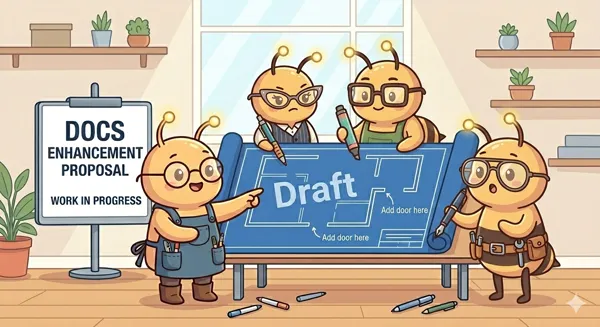
Week three is about turning understanding into action. Share your enhancement draft and ask for feedback in writing. Come with an open mind: there will be a lot of comments, and your initial idea will likely change completely. That’s not personal. It’s the beauty of review. We learn from each other.
Suggest a lightweight process: enhancements as the unit of discussion, not endless meetings. Propose defining “minimum value” for the current phase. What’s the smallest deliverable that matters? Get one enhancement to a reviewable state. It doesn’t have to be perfect. Schedule a short review session and identify one thing the team can agree on as “next.” That’s your first milestone.
Week 4: Reflect and adjust
The last week of the first month is for reflection. What’s the biggest blocker: process, technical, or people? What worked and what didn’t? Who are your allies? Who needs more time to buy in?
Then plan the next 30 days. What’s the one thing you want to achieve? What’s the one thing you’ll stop doing or change?
A checklist to take away
If you want something concrete to work from, here’s the checklist in condensed form. Use it, adapt it, or ignore what doesn’t fit.
Week 1
- List repos and roles
- Find docs and diagrams
- Talk to 2–3 people with different perspectives
- Draw high-level diagrams to capture your understanding
- Share and correct
Week 2
- Identify where decisions are recorded
- Check if there’s agreement on sequence of work and definition of done
- Assess minimum viable foundation and built vs. planned
- Watch for scope creep
- Draft one enhancement proposal
Week 3
- Share the draft
- Ask for written feedback
- Propose enhancements as the unit of discussion
- Define minimum value
- Get one enhancement reviewable
- Agree on “next”
Week 4
- Reflect on blockers and what worked
- Identify allies
- Plan the next 30 days
Every project is different. The goal is to move from “I’m lost” to “I know where I am and what to do next.” If you’re in that first month, what’s on your list? I’d love to hear from you on LinkedIn.
I’m planning to write more about the parts that are still unclear: enhancements, feedback, how to handle meetings, and more. There’s a lot to explore.
Images in this post were generated with Google Gemini.